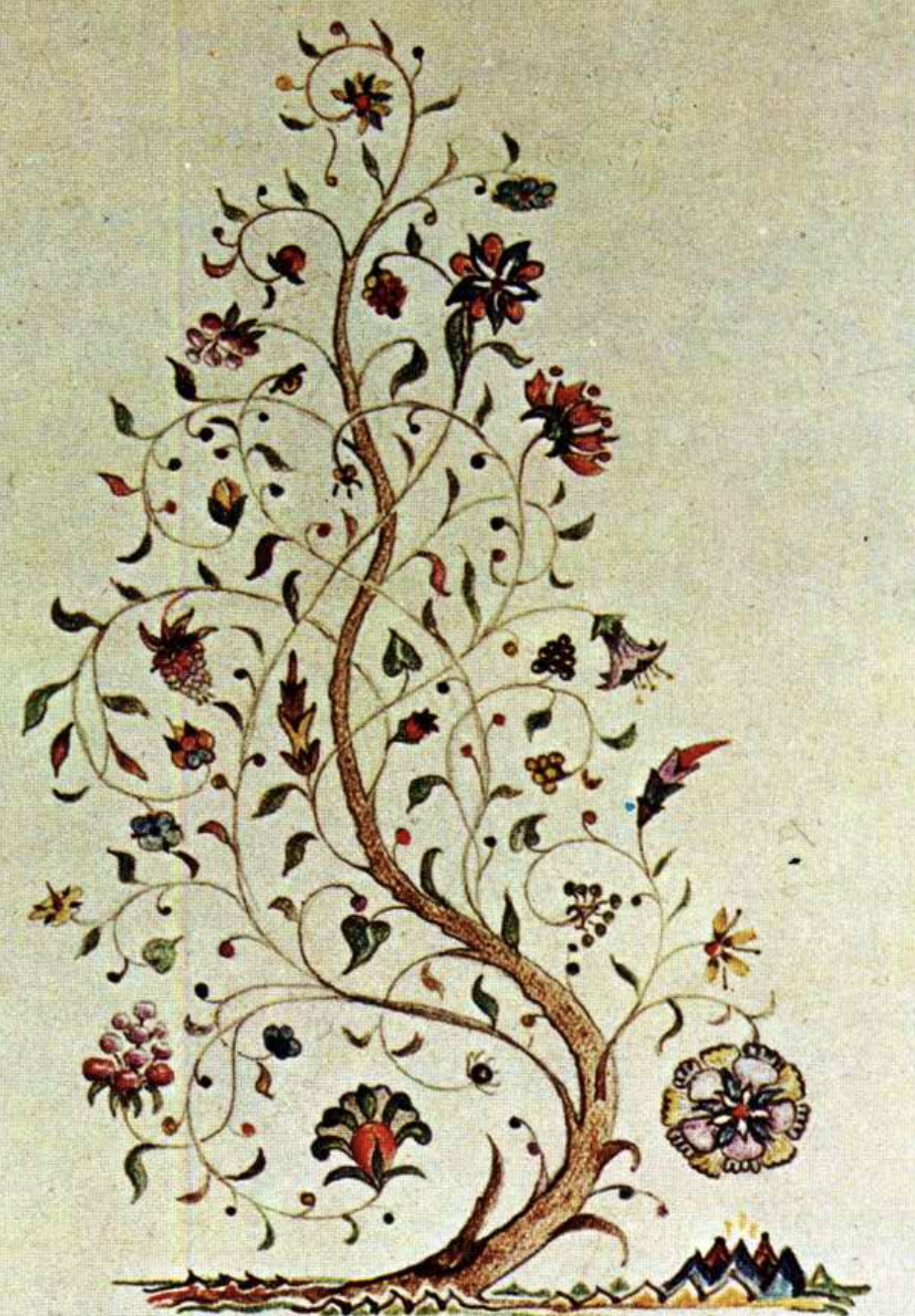
Image: The Tree of Amalion by J.R.R. Tolkien
In preparing to expand my studies beyond the MA classwork and thesis, I have found myself going back to basics in the questions I’m asking myself. Why study Tolkien? Well – I quickly realized that this is really two separate questions: why Tolkien (and what does that mean to me), and why study?
To address these, I want to first go back to my recent work on The Notion Club Papers. In my thesis, I argue (amongst other things) that the complex narrative structure of the Papers – often read as burdensome and ultimately fatal to the project – is necessary to the thematic success of the story, a delicately crafted and fundamentally unstable edifice, purposefully designed to be deconstructed at each level. This is an unusual strategy, one which allows the story itself to break through the narrative and the bounds of literature to interact with the Primary World.
On a simply intertextual level, The Notion Club Papers is in dialogue with Tolkien’s earliest creative work: his Ishness paintings, his early poetry, and the Lost Tales, but also his developing theories of native language, ancestral consciousness, dreams, and the sources of creativity and inspiration. More consciously perhaps, the metacommentary of the Notion Club and the movement of the characters through time and consciousness toward Númenor draws on the contemporary time-travel writings and experiments of engineer-turned-philosopher J.W. Dunne. To this point, the work is, curiously, almost entirely unique amongst his legendarium and legendarium-adjacent writings in being given a fully modern context (excluding, perhaps, Roverandom), a temporal setting that is even projected into the future by more than 50 years.
Furthermore, within this web of intertextual summons is hidden also the voices of the Beowulf poet, the Irish immrama, and, crucially, Tolkien himself – a member of the now-forgotten and “Public-house School” (the Inklings) and writer of “all the elvish stuff” which is “badly out of fashion” and barely tolerable even to the members of the Club (Sauron Defeated 193, 200, 219). As a mythologized lost source (one of many) for the rumor of Númenor, Tolkien becomes another character in the story, able to participate his own creations while also being absorbed into the mythic Soup.
I am drawn to each of these things in turn – the work itself, its intertextual sources and relationships, the first forms of these images and impressions in the mind of the author, and the process by which they came to be included (often in their original form) in this bizarre little abandoned tale across many decades of creative work. For me, the creative mind and process is just as interesting as the stories themselves – or rather, seeing story as situated within the larger context of creative life and living. Thinking even further afield, The Notion Club Papers gestures at the assumption of the reader into the same continuum of story: “People of the future, if they only knew the records and studied them, and let their imagination work on them, till the Notion Club became a sort of Secondary World set in the Past: they could” (228). The ontological implications of this and other odd digressions of the Papers are fascinating to me, contributing further to the picture of stories working outside the bounds of literature.
And this, at last, brings me back to the question(s): why study Tolkien?
Taking this question in halves – why Tolkien? There are three answers that readily come to mind. First, because I find his works enchanting, which is in itself reason enough to provoke curiosity as to the workings of successful fiction. Second, because his creative process is uniquely well-documented. The body of material edited and published by Christopher Tolkien, ranging from drafts of his major works, to essays (and partial-essays) exploring the development of his thought on a great number of topics within the legendarium, to early poetry (and fragments of poetry), sketches, and even the smallest of notes and outlines documenting his father’s thought as the world emerged. Others have pushed the corpus forward, with expansive critical editions of other essays and short stories, a large quantity of linguistic material, additional letters, and, this year, dozens of previously unpublished poems. The level of access not only to Tolkien’s creative output, but to his process, offers a unique opportunity for scholarship.
And third, because Tolkien continued work on a single project throughout his life, like Niggle finding that his tree of story “grew, sending out innumerable branches” with most other ideas and projects coming to be “tacked…on to the edges of his great picture” (Leaf by Niggle 10-11). The legendarium seems to have been a complete expression of Tolkien’s creative thought, a story large enough to contain a life and mind, encapsulating the vision of a deeply learned and strongly inspired creative over his lifetime and developing alongside its author. To study the works – particularly in continuum with each other with a mind for their growth, change, and maturation – is to study the process, and through the process to discern a vision of creativity at work. I have found that my interest and research gravitates toward what might be labeled biographical criticism, but that is not quite true to my aims. I am less interested in Tolkien the person – the very real father, husband, friend, scholar, teacher, and even “author” – but rather the record of Tolkien’s creative life.
As for the second half of the question – why study? This one is a little harder to articulate. I find that in seeking an understanding of inspiration and story, of creative process, power, and vision, it is almost as if one could study the independent life of story itself as it lives alongside its creator. Where does it come from, or rather, from what does it seem to flow? What core memories are formed in its childhood, and where does that inner child reside amidst its more mature forms? How does it struggle, grow, integrate, and individuate? I have found, and it is my hope that I will continue to find, answers to these questions as I continue to study the enchantment for itself and on its own terms. Even better, I hope to find bigger and truer questions to pursue.
Returning to the Notion Club and the ways in which stories work outside the bounds of literature, I think I was drawn to this story in particular because it intersects in interesting ways with some of the central interests of my life – my intellectual life, my spiritual life, my creative life, and even my family and community life. As with anything, articulating the questions is itself a large part of answering them, so consider these each a work in progress:
- What is the power of a life lived through story?
- In what way are the stories we consume and the stories we create in relationship with the regular, secular, (typically) unenchanted or mundane aspects of life?
- How do we map or project stories onto the physical world around us, and how does this enchant (or not) our relationship with our surroundings?
- How might the patchwork of stories that we live and live through, those that touch us at any point in our lives, be woven into our own personal narratives?
- In what way do our personal narratives change our reality (and I mean this more literally than not)?
- What is the eschatological trajectory of the stories we live through?
At some point, I hope to explore each of these in a little more detail on this blog, primarily offering brief explanations in order to draw parallels to my study of Tolkien. Each of these is, for me, a whole conversation in itself – so I will likely be brief. For now, I will say that there are a couple elements that permeate my interests and my lens. To begin with, my approach is clearly one of a Jungian bent, and though time is precious (particularly with an infant!), I hope to continue exploring Jungian theory on a deeper level as my studies continue. There are also elements of of mystic or esoteric thought to be brought to bear on these topics, and I have just begun scratch the surface on these rich and fascinating traditions. More, I suppose, for a later time. Finally, it is also inescapable that one of the obvious answers to how to approach these questions (particularly in relation to literature) would be to write fiction myself. I have pursued this road in the past, with much difficulty, as for many, in my relationship with anxiety, imposter syndrome, and self-esteem. While I may return to these goals someday in the future, I have learned that there are many paths to living story, and I have found that the exploration of writing is not always about learning how to write well, but rather seeking to understand humanity and our reality by learning from those that do. If I myself write well along the way, that is in some ways a byproduct – I want to live the story.
My current intentions for this blog are to fill out some of the topics I pursued in my thesis around The Notion Club Papers. I’d like to be able to explore some of the side-tangents I didn’t have the time for in my research, rework some of the bits that didn’t make it into my word count, and contextualize more portions of what I did include within my broader interests. I would also like to pursue an entirely separate line of writing and research on the many topics that have caught my eye that I have not yet written about, primarily on Tolkien’s early work. Likely, I will alternate between the two. It is my hope that the through-lines in my interests will emerge, and I am eager to discover the broader themes as I develop my voice as a scholar. Many adventures here to be had!
Works Cited:
Dunne, J.W. An Experiment with Time. Charlottesville, VA: Hampton Roads Publishing Company, Inc, 2001. Print.
Tolkien, J.R.R. Leaf by Niggle. London, UK: HarperCollinsPublishers, 2016.
Tolkien, J.R.R. “The Notion Club Papers.” Sauron Defeated, ed. Christopher Tolkien. London, UK: HarperCollinsPublishers, 2015, 145-330.
 Notions in Progress